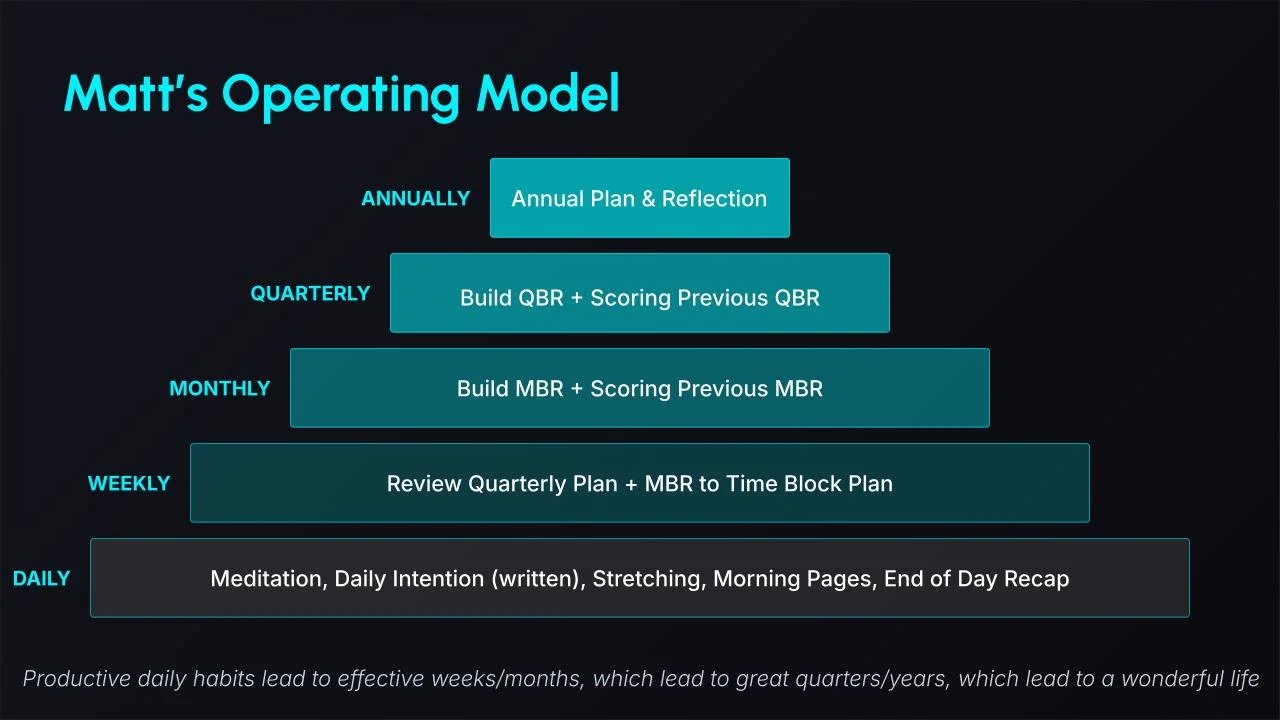
We know how we spend each day is important. There are endless platitudes that come back to how important each day is. Let’s try 3:
“How we spend our days is, of course, how we spend our lives” - Annie Dillard
“Most people overestimate what they can do in one year and underestimate what they can do in ten years." - Bill Gates
“You’ve got to be very careful if you don’t know where you’re going, because you might not get there." - Yogi Berra
With the goal of making the most of each day, week, month, quarter, and year, here is where I’ve landed.
The picture is useful, but allow me to further elaborate.
Daily
Meditation + Stretching: I haven’t found a better way to start the day. If I miss a day, I notice. Starting the day by centering my mind and body is the best way to start the day.
Written Intention + Morning Pages: How do you know what you’re trying to accomplish each day unless you write it down? This has been a great exercise to make sure I am focusing my time and energy on what’s most important in a given day. I don’t limit myself to one intention, but if I come up with more than 3, I’m trying to do too much in one day. When the intention has been written down, I work on my morning pages (the idea comes from Julia Cameron’s excellent book, The Artist’s Way).
End of Day Recap: Several short questions that I answer every day. These answers give me the data I need to measure progress against my Monthly Business Review (MBR) and Quarterly Business Review (QBR), but more importantly, they allow me the time and space for a short reflection each day. For example, every day, I write a sentence to capture my favorite part of the day with my wife, Taylor. I also write something about her that I’m grateful for. At the end of the year, I have 365 sound bites. Last year, I used these to send her 10 per day during her birthday month. This generated awesome conversation, allowed us to reflect on the previous year, and was a gift that money can’t buy.
For a few more examples, I also write what I’m grateful for, if I exercised, how I slept, what I did that was kind to others, how much time I spent on my business, if I drank caffeine or alcohol, if I ate well, my favorite part of the day, what I learned that day, what I had for dinner (looking back at what we had for dinner for the last quarter is useful to make future meal plans)… I think you get the idea.
This may sound like a lot, but I set up a Google Form (which took 10 minutes) and connected it to a spreadsheet (which only I have access to). I then created a shortcut on my phone to open the Google form (it looks like an app). When I walk the dog each night, I use dictation to answer the questions and score the day. It takes about 5 minutes, but the data at the end of the month/quarter/year has been invaluable.
Weekly
Review QBR: A lot can be accomplished in a quarter. Before building my weekly plan, I always review my quarterly plan to ensure I’m making progress against the things that matter.
Time Block Plan: This is the single most underutilized practice to ensure you spend time on your priorities, rather than just reacting to what your inbox or Slack tells you is important.
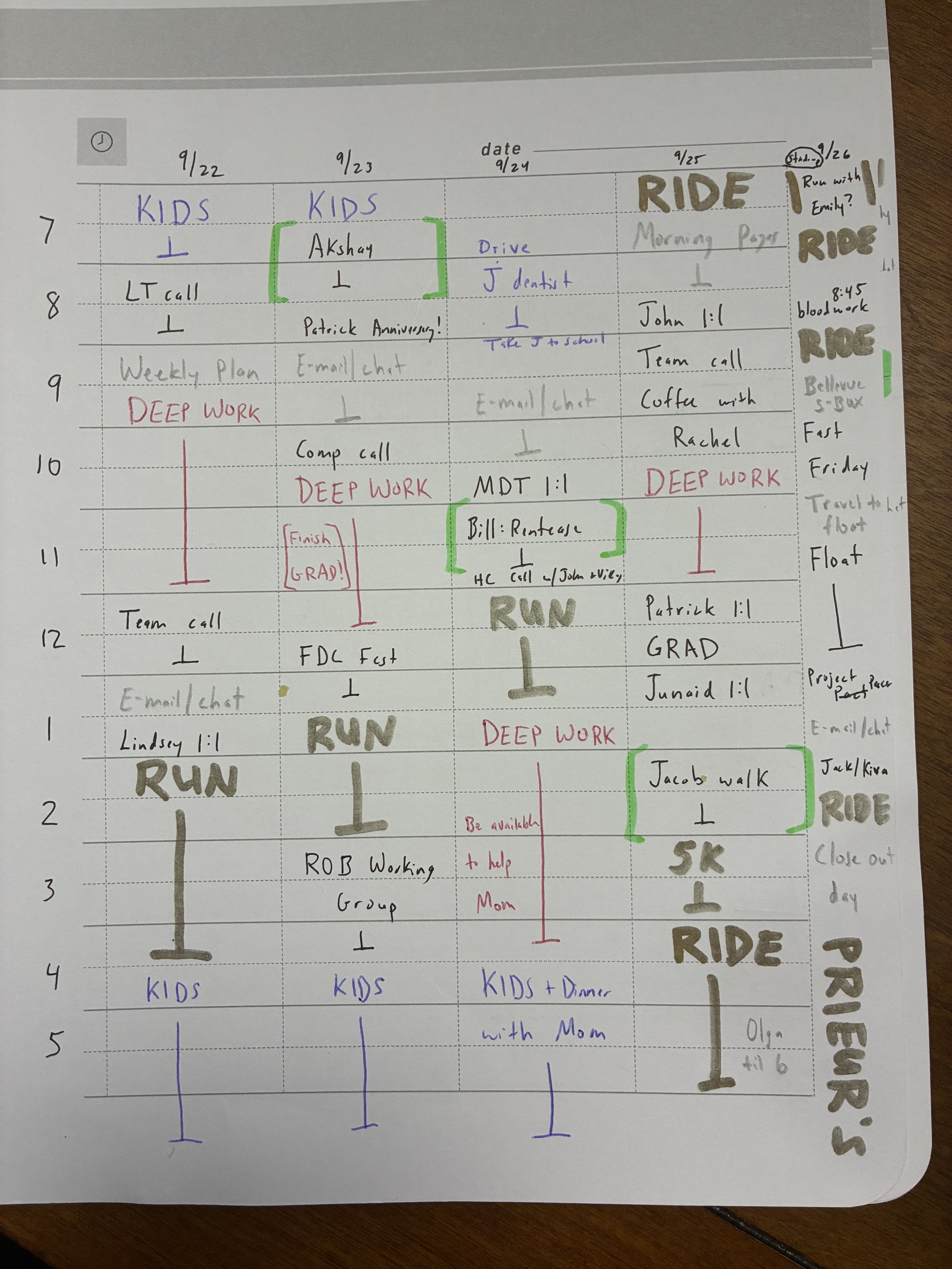
Every Monday morning I take 10 minutes to write down all of the things that are on my calendar. this is a good time to make sure the important things for the week (that require a meeting) are actually on the calendar and accounted for. Then, using my QBR as a guide, I build in time to do the things that I want to make progress on. This is the magic. I schedule time to run, spend time with friends and family, and work on projects (both inside and outside of work) that are important to me. Then, as I move throughout the week, I never need to guess on what I’m supposed to do during work hours, I just look at my plan and execute.
2 common FAQs:
Doesn’t this zap your creativity as it removes spontaneity? No, in fact, it does the opposite. When you know you have time to do the creative thing later in the day, you get rid of the thought of “I should be doing that thing right now.” In addition, knowing you have 60 minutes to solely focus on something that’s important allows you to put your full energy into one thing at a time.
Do you time block non-working time? No. Building and executing a time block plan is super effective, but also hard. Time blocking personal time isn’t a good use of energy.
Monthly
Build MBR & Score Previous: Each month create a MBR and score/review the previous MBR. These fill a half page and are printed, cut out, and taped into my notebook. This way, I can see progress over time and they aren’t lost in a file on my computer. I also have a list of 15 metrics that I track each month.
To build the MBR, I pick a focus area and define the goals that I want to achieve. Similar to the time block plan, this is also based on what I want to accomplish from the QBR. The process of creating and scoring the MBR takes 15 minutes per month.
Fun fact: One of my goals from my last MBR was to write this article and yes, I did put 60 minutes on my time block planner to execute :).
Quarterly
Build QBR & Score Previous: Similar to the MBR, each quarter I create a QBR and score/review the previous QBR. I use my annual plan as a guide as well as things I’ve learned during the quarter that I want to implement. The QBR goals are aligned to the following categories: Overall goals, family/friends, health, primary business, other business, personal development. This takes about 15 minutes.
Annually
Annual Plan and Reflection: Each year, on or around my birthday I go somewhere quiet (often a bench in the woods) and write a page or two about the last year. Where I made progress, where I didn’t, how I have changed for the better, how I have changed for the worse. I then write what I want to be true a year from now. This is more high-level than a tactical QBR or MBR. It’s more about the person I want to become and how I can keep growing. I look forward to this exercise each year. It takes about an hour to complete, but I spend a lot more time than that thinking about it in the days leading up to my birthday.
Conclusion
Did you make it this far? If so, thanks for reading! I hope there’s at least one idea in here that you can take with you. If you have questions, send me a note or if you’d like to schedule a session, you can do that here.